- Payroll
Hiring your first employee in Cyprus: the complete employer checklist
Registering as an employer, the ERGANI notice, 2026 rates and minimum wage, monthly deadlines and payslips. Sumly runs the payroll and books it, €15 per employee a month.
 Sumly team
- Published
- 8 min read

On this page8 sections
Your first hire makes the company an employer. That's a registered status with its own numbers, filings and deadlines. Before the start date, you register with the Social Insurance Services and notify the hire through ERGANI. From the first payday you run payroll every month, and you pay over everything you deduct or owe by the end of the following month. Budget about 15.4% on top of the gross salary. That's what employer contributions add in 2026.
How do you register as an employer in Cyprus?
You apply to the Social Insurance Services for employer registration. The employer number you get back is the reference for every contribution payment and employer return you'll ever file. Your company registration doesn't cover this. A registered company and a registered employer are two separate records, and plenty of founders find out about the second one a week before the first payday.
You notify the hire through ERGANI, the online system of the Social Insurance Services. The deadline is strict. You must do it no later than one day before employment starts. There's no paper option, because the paper declaration was abolished in September 2021. Since January 2025 you also register the employee's essential employment terms in ERGANI, a duty added by decree KDP 455/2024.
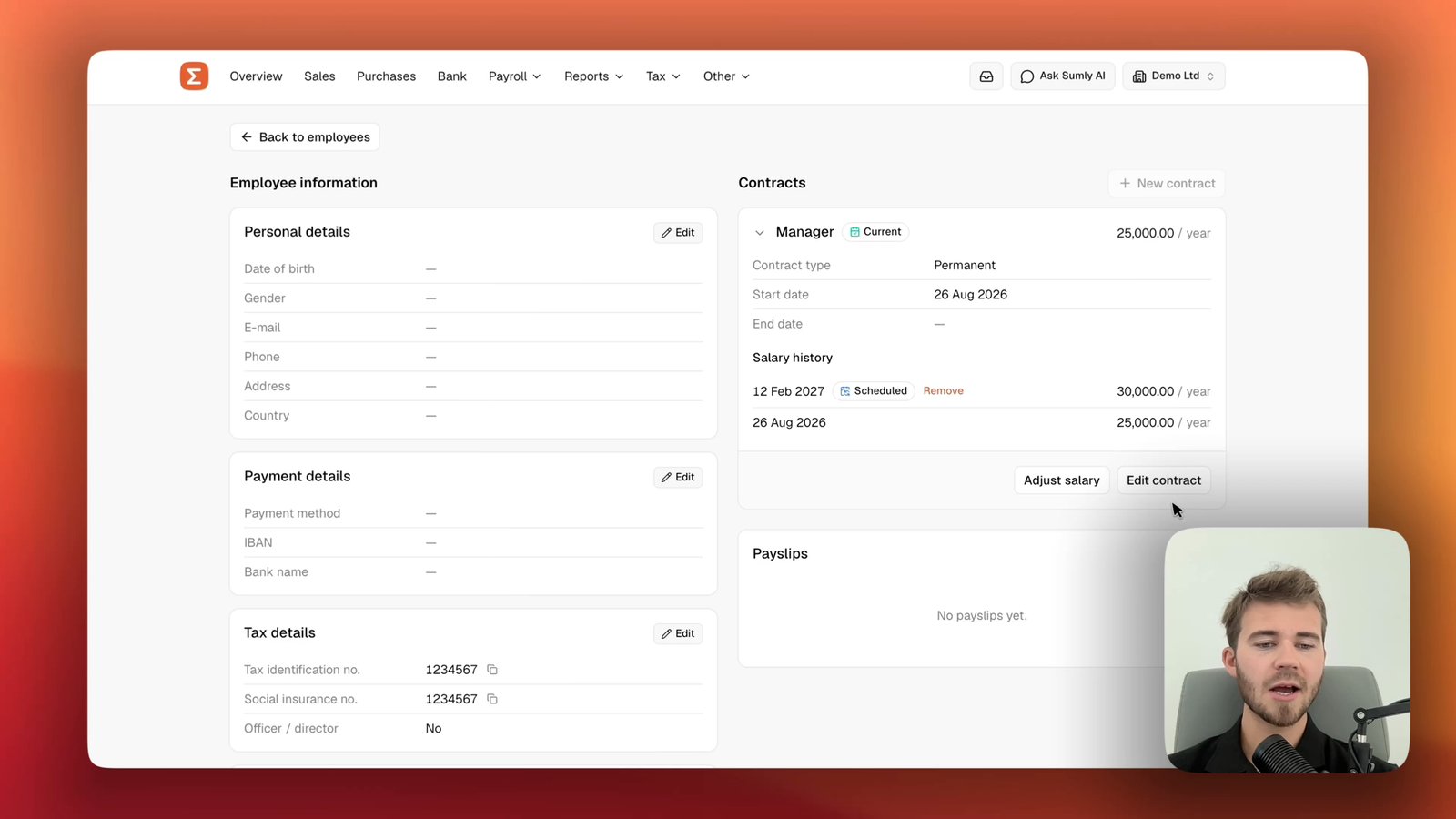
Collect two numbers during onboarding: the employee's social insurance number and their tax identification number, the TIN. The monthly employer return needs the TIN, so get it now instead of chasing it in month three.
Still deciding between an employee and a supplier? Start with the employee-versus-contractor guide. Look at how the work will actually be arranged before you choose payroll or invoices.
What has to be in writing, and by when?
The core terms within seven days, and the rest within a month. You must give the employee the essential terms of employment in writing, on a timetable set by law. The core terms are the parties, the place of work, the job, the start date, any probation, the pay and the hours. They go out within seven calendar days of the start, and the remaining terms follow within one month. This comes from the Transparent and Predictable Working Conditions Law of 2023. Any later change to a term has to be in writing by the date it takes effect.
The failure we see most with first hires isn't a badly drafted clause. It's having nothing in writing at all, because the first employee was a friend or a former colleague and everything felt understood. The written statement is what an inspector asks for. It's also what settles a dispute two years later, when memories differ.
Legal minimums are floors. Annual leave, public holidays, notice periods and the minimum wage apply even where the contract says less, so a clause below the floor has no effect. If the arrangement is unusual, say remote work from another country or a fixed-term contract, have it checked before signing.
What does an employee cost above the gross salary?
About 15.4% more than the gross salary. Five employer charges sit on top of the gross, and none of them is ever deducted from the employee: Social Insurance at 8.8%, the Redundancy Fund at 1.2%, the HRDA fund at 0.5%, the Social Cohesion Fund at 2%, and GeSY at 2.90%. GeSY is the national health system. HRDA is the Human Resource Development Authority, which funds training.
Say you offer €2,500 gross a month. On top of that, the company pays €220 Social Insurance, €72.50 GeSY, €30 Redundancy, €12.50 HRDA and €50 Social Cohesion. That's €385 in all, so the hire costs €2,885 a month before you've bought them a laptop. The employee also has their own 8.8% Social Insurance and 2.65% GeSY deducted from the gross, plus PAYE based on their income. Try the numbers on your own offer with our salary calculator.
| Social Insurance, employeeDeducted from gross pay | 8.8% |
|---|---|
| Social Insurance, employerPaid by the company on top of the salary | 8.8% |
| GeSY, employeeDeducted from gross pay | 2.65% |
| GeSY, employerPaid by the company on top of the salary | 2.90% |
| Employer-only fundsEmployer cost only, never deducted from the employee | Redundancy 1.2% · HRDA 0.5% · Social Cohesion 2.0% |
| Maximum insurable earningsCaps Social Insurance, Redundancy and HRDA. The GeSY cap is separate. | €5,742 a month for 2026 (€1,325 a week, €68,904 a year) |
The charges stop at three different points, which is why a high salary is harder to estimate than a low one. Social Insurance, Redundancy and HRDA apply to insurable earnings up to €5,742 a month in 2026, a ceiling revised each January. GeSY runs until total annual income reaches €180,000. The Social Cohesion Fund applies to all emoluments, meaning everything you pay the employee, with no ceiling. Our guide to Social Insurance in Cyprus takes each layer in turn, and GeSY contributions explains why the health contribution reaches dividends as well as salary.
Social Insurance Law 59(I)/2010
employer registration and contribution obligations
Official sourceChecked 26 August 2026
What is the minimum wage in Cyprus in 2026?
From 1 January 2026 the national minimum wage is €1,088 gross a month, or €979 gross until the employee completes six months of continuous work with the same employer. It was €1,000 and €900 before. It doesn't cover domestic workers, agricultural and livestock workers or seafarers, and hotel staff have their own decree. The rate is adjusted on a two-year cycle, so the next change takes effect on 1 January 2028.
Contributions are worked out on actual earnings, so a minimum-wage hire carries the full set of deductions and employer costs above, just on a smaller base. Weighing a modest salary for yourself as director against dividends? That trade-off has its own moving parts, and our salary vs dividends guide works through them.
When do you pay the contributions and PAYE?
By the end of the month after the pay month. In practice that's two payments. The Social Insurance contributions go to the Social Insurance Services, both the employee share you deducted and the employer share the company owes. The PAYE and GeSY withheld from salaries go to the Tax Department, together with the company's own GeSY contribution. Since January 2026 that side runs monthly. You file a monthly TD7 return in Tax For All, due with payment by the end of the following month, plus an annual TD7 that reconciles the year. The TD7 is the employer's return of the tax it withheld, and Tax For All, or TFA, is the government tax portal.
Use the TD59 form to collect the employee details behind the withholding calculation. Our TD7 guide covers preparing employer returns, reconciling the annual totals and keeping proof that you filed and paid.
File the TD7 before you try to pay, because the return is what creates the amount owed on your TFA account. Payment has gone only through TFA since 22 August 2025. Late payment of withheld PAYE carries a 1% surcharge a month, with interest on top after a further month.
What has to be on a payslip?
An itemised breakdown of the pay, within five working days of payday. Every employee must get one. Under the Protection of Wages Law it must show the employer and the employee, the payment date and the period it covers, and the basic pay with the hours it corresponds to. It also shows any overtime and how it was calculated, any other payments, and every deduction on its own line. That way the employee sees Social Insurance, GeSY and PAYE separately, because they're three different charges under three different laws.
The same law says salaries go into a bank or payment account the employee chooses. You must also keep a payslip archive and produce it to a Labour Inspector within 15 calendar days of a request. A payslip that only ever existed as a screen the employee glanced at once fails that test. Keep them. They're the record behind every payroll figure in your accounts.
How Sumly runs your payroll
The payroll add-on does the monthly work. It calculates Social Insurance and GeSY at the rates in force, emails each employee their payslip, prepares the employer filings and posts every run straight into your books. So the liability at month end and the bank payment that follows reconcile without a year-end hunt. A person submits the filings: you on Base, Sumly on Plus, or your Sumly certified bookkeeper on Premium. It costs €15 per employee a month on top of your plan, and the payroll feature page shows the full scope. The software starts with a 30-day free trial, so you can run your first payslip before you pay us anything.
Questions first-time employers ask
Common questions
Keep reading.
- Payroll
- Tax
TD59 in Cyprus: the employee declaration behind your PAYE
What Cyprus TD59 is, where to find the current English form, what employees give their employer and how to check the information before payroll.
Sumly team5 min read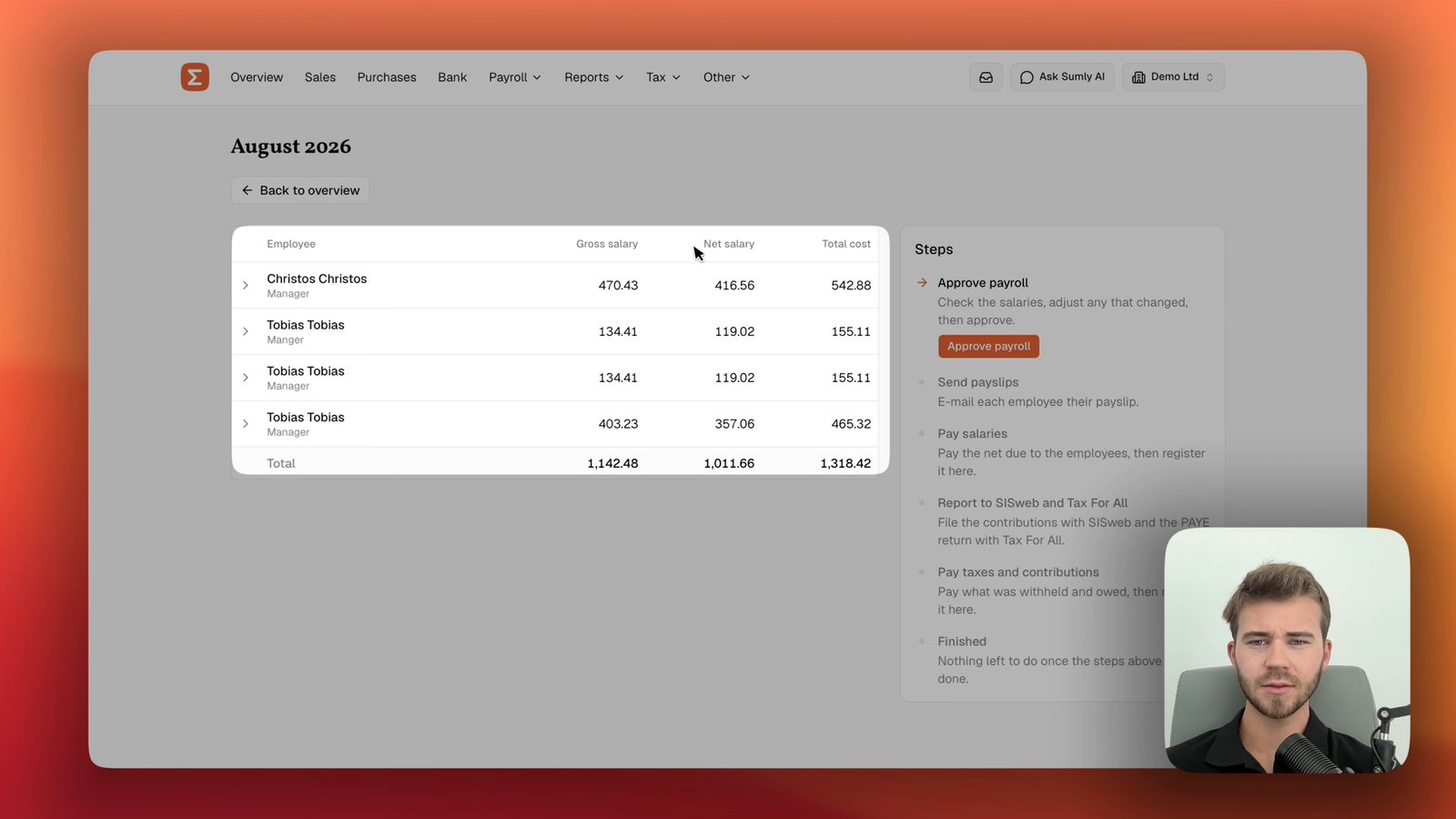
- Payroll
- Compliance
TD7 employer returns in Cyprus: monthly and annual filing through Tax For All
Prepare Cyprus TD7 employer returns from payroll, reconcile the annual totals, fix errors and keep proof of filing and payment in Tax For All.
Sumly team6 min read- Payroll
- Compliance
- Bookkeeping
Employee or contractor in Cyprus? Check the working relationship before you hire
Employee or contractor in Cyprus? Judge the arrangement on the real working conditions, then set up payroll or supplier bookkeeping with the right records.
Sumly team5 min read
Ready when you are.
Start a new company, or bring the one you already have.