- Payroll
GHS (GeSY) for Cyprus company owners: what you pay on salary and dividends
What GeSY costs a Cyprus company owner in 2026: 2.65% plus an employer 2.90% on salary, 2.65% on dividends, one €180,000 cap, and no non-dom exemption.
 Sumly team
- Published
- 8 min read

On this page8 sections
Yes, you pay GeSY on both routes out of your own company. GeSY, or GHS in English, is the General Healthcare System, Cyprus's national health scheme. The contributions that fund it go by the same name. A salary carries an employee share of 2.65%, plus an employer share of 2.90% that your company pays on top. A dividend carries 2.65% in your hands, and being a non-dom doesn't remove it. A non-dom is a Cyprus tax resident who isn't Cyprus-domiciled, usually because they moved here from abroad. The one limit is the cap. Contributions stop once your total income for the year reaches €180,000, counted across every source together.
Why GeSY hits a company owner from three directions
Because you sit on both sides of the payslip, and then take dividends too. An ordinary employee pays GeSY once. When you draw a salary from your own company, you're the employee whose share comes out of gross pay. You also own the employer that adds its share on top, so both halves come out of the same business. When the company then pays out profit, the dividend is contributable income too, at the individual rate. Our explainer on GeSY contributions in Cyprus covers who pays what across the whole system. This article is only about the owner's position.
The most common mistake we see is treating GeSY as a rounding error. Owners model income tax and Social Insurance carefully. Then at year end they find that a large dividend carried a four-figure health contribution nobody had budgeted for. On salary the amounts are modest. On dividends, until you reach the cap, they're real money. And GeSY is the one charge on dividends that neither non-dom status nor the 2026 reform touched.
General Healthcare System Law 89(I)/2001
contributions on income: employees, employers, shareholders and other income earners
Official sourceChecked 26 August 2026
What a director's salary carries in 2026
Three separate charges, and GeSY is the smallest. The employee's Social Insurance and GeSY come out of gross pay, together with PAYE, the income tax the company withholds from each payslip. The company pays the employer's Social Insurance, the employer-only funds and the employer's GeSY on top.
GeSY runs at 2.65% for the employee and 2.90% for the employer, and Social Insurance at 8.8% for each side. The company alone also pays the Redundancy Fund at 1.2%, the HRDA fund at 0.5% and the Social Cohesion Fund at 2%. HRDA is the Human Resource Development Authority. The insurable earnings ceiling for 2026 is €5,742 a month, €68,904 a year.
| GeSY, employee shareDeducted from gross pay | 2.65% |
|---|---|
| GeSY, employer sharePaid by the company on top | 2.90% |
| Social Insurance, employeeDeducted, up to the insurable ceiling | 8.8% |
| Social Insurance, employerCompany cost, up to the insurable ceiling | 8.8% |
| Redundancy FundEmployer only, up to the ceiling | 1.2% |
| HRDA fundEmployer only, up to the ceiling | 0.5% |
| Social Cohesion FundEmployer only, no ceiling | 2.0% |
| Insurable earnings ceiling€68,904 for 2026; GeSY has its own, higher cap | €5,742 a month |
Add up the employer side and every €100 of gross salary costs the company €115.40 below the ceiling. The company also withholds PAYE across the 2026 bands: nothing up to €22,000, then steps of 20%, 25% and 30%, and 35% above €72,000.
People mix up the two ceilings in that stack all the time. The Social Insurance ceiling applies to salary only and stops at €68,904. The GeSY cap is €180,000 and counts income from every source. The salary calculator shows the full employer cost next to the net pay, and our Social Insurance guide walks through each contribution line.
Do you pay GeSY on dividends as a non-dom?
Yes. A dividend paid to a Cyprus tax-resident individual carries GeSY at 2.65%, whatever your domicile. Cyprus non-dom status exempts you from Special Defence Contribution, or SDC, on dividends, interest and rent for up to 17 years of tax residence, and that exemption is worth a lot. But it sits in the SDC law. The health contribution comes from a different law, and that law never asks where you're domiciled.
So for a non-dom owner, a dividend carries no SDC, no income tax, and GeSY up to the cap. Dividends are free of income tax under art. 8(20), whatever your domicile. A domiciled owner pays SDC at 5% on dividends out of 2026-and-later profits, plus the same GeSY. Where the dividend comes out of pre-2026 profits paid out before the end of 2031, the SDC is 17%. The reform narrowed the gap between the two groups and left the health contribution alone for both.
How the €180,000 cap works across salary and dividends
It's one ceiling across everything. Salary, dividends, rent and self-employment profits are added together, and GeSY is charged on the total up to €180,000. Earnings count first, then pensions, then other income such as dividends. Once the total passes the cap, nothing more is due for the year, whichever source the extra income comes from. If more was collected than that, you can apply to the Tax Department for a refund.
Say you pay yourself €60,000 of salary and a €100,000 dividend in 2026. The salary carries €1,590 of employee GeSY and €1,740 of employer GeSY through payroll. The dividend carries €2,650, which the company withholds when it pays you. Your contributable income is €160,000. That's under the cap, so every euro contributes.
Raise the dividend to €150,000 and the total becomes €210,000. The salary uses the first €60,000 of the cap, the dividend fills the remaining €120,000, and the last €30,000 of it carries nothing. That's also why €4,770, which is 2.65% of €180,000, is the most GeSY you'll personally pay in any year.
Before you declare the next dividend, check where you stand against the cap. That's a bookkeeping question, and keeping payroll and dividends in the same books answers it.
Does GeSY change the salary or dividends decision?
Less than owners expect, because it sits on both sides at the same personal rate, under the same cap. The choice turns on the layers that differ. Salary is a deductible cost for the company, but it carries PAYE across the bands and Social Insurance for both employee and employer. A dividend comes out of profit that has already paid 15% corporate tax. It then carries SDC for domiciled shareholders and nothing for non-doms. Salary also buys pension and benefit rights that dividends never do.
Our guide to salary vs dividends for Cyprus company owners stacks up both routes in full. If your residency or domicile spans two countries, have a tax adviser confirm the split before you fix it.
One reform change is worth knowing before you take money out informally. From 2026 a domiciled shareholder pays SDC at 10% on disguised distributions. That mainly means the value of company assets a shareholder uses personally, and the shortfall when the company sells an asset to a shareholder below market value. A properly declared dividend never triggers it. A company car that doubles as the family car can.
How the contribution actually gets paid
On salary, it goes through payroll every month. The company declares the employee's deducted share and the employer's share on the monthly TD7 in Tax For All, the Tax Department's online portal. It pays them by the end of the month following the salary month, together with the PAYE withheld from the same salary. Social Insurance goes to the Social Insurance Services on its own monthly run. None of this is special for a director. The company is the employer, you're an employee on its payroll, and the company handles the filings.
On dividends, the company withholds at source. When a Cyprus company pays a dividend to a Cyprus tax-resident individual, it must deduct the 2.65% GeSY and pay it to the Tax Department. It declares the GeSY, with any SDC it withheld, on form TD603, using code 703 for GeSY and 603 for SDC. You declare and pay it yourself only where no Cyprus payer withholds, which in practice means dividends from foreign companies. In that case you pay it directly by your tax return deadline.
In the books, record three amounts on the date the dividend is declared: the gross dividend, the contribution withheld and the net paid to you. A bare transfer of company cash to a shareholder isn't a dividend. Without the paperwork, it sits as a director's loan, with its own tax consequences.
How Sumly handles GeSY for a director
Sumly's payroll add-on puts you on the payroll like any other employee. It calculates the employee and employer GeSY shares alongside Social Insurance and PAYE, emails the monthly payslip, posts every run to the books automatically and prepares the employer filings. On Base, you review and submit them. On Plus, Sumly files them for you, along with your VAT and VIES. On Premium, your Sumly certified bookkeeper does it. The add-on costs €15 per employee per month on top of your plan.
Dividends benefit from the same books. Payroll, the dividend entries and the bank feed land in one ledger, so you can see your contributable income for the year. Before you decide on the next dividend, you can ask Sumly AI where you stand against the €180,000 cap. If you're about to hire beyond yourself, the same payroll run covers your first employee from the day they start.
Questions company owners ask us
Common questions
Keep reading.

- Payroll
Hiring your first employee in Cyprus: the complete employer checklist
Registering as an employer, the ERGANI notice, 2026 rates and minimum wage, monthly deadlines and payslips. Sumly runs the payroll and books it, €15 per employee a month.
Sumly team8 min read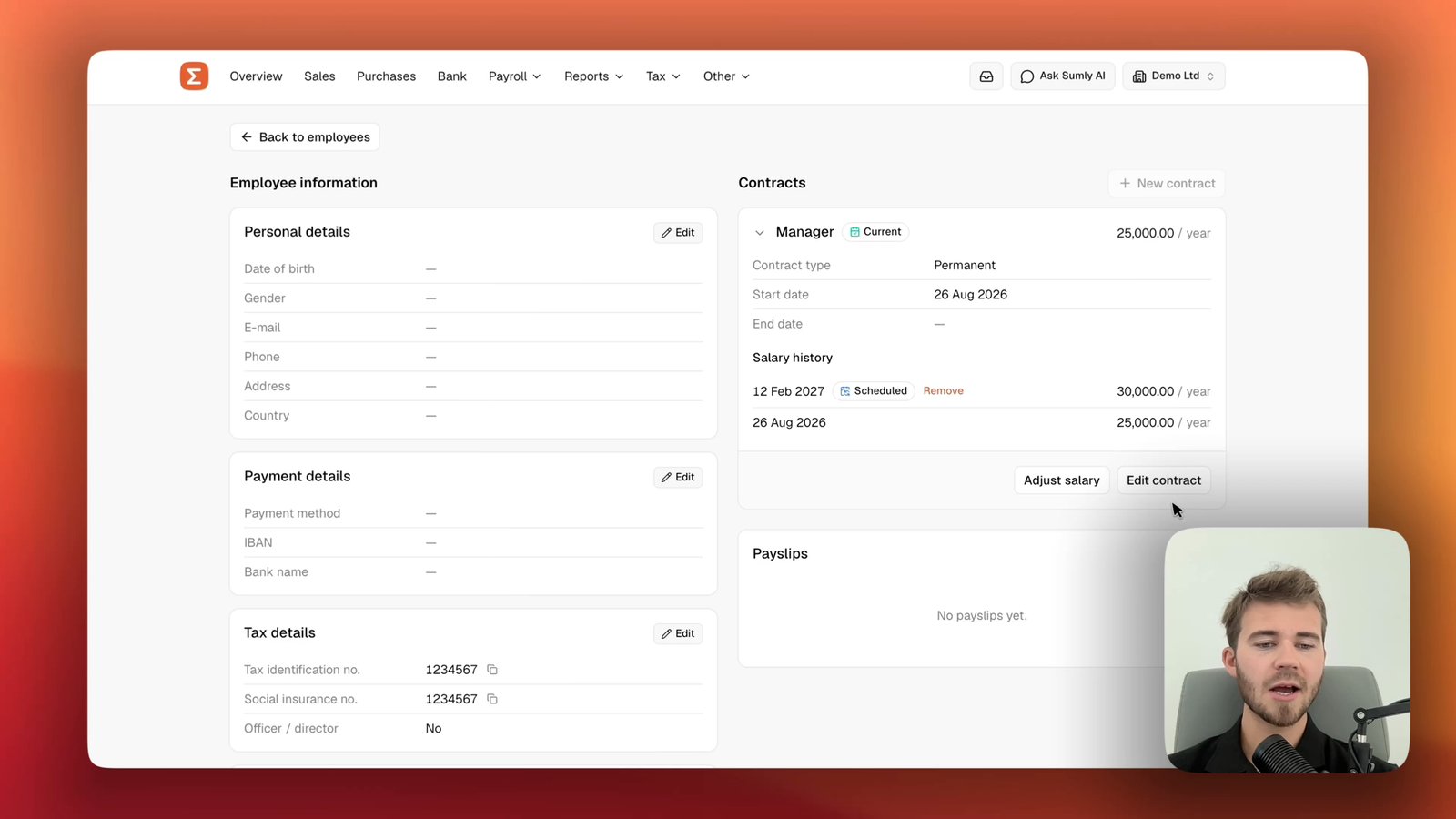
- Payroll
- Tax
TD59 in Cyprus: the employee declaration behind your PAYE
What Cyprus TD59 is, where to find the current English form, what employees give their employer and how to check the information before payroll.
Sumly team5 min read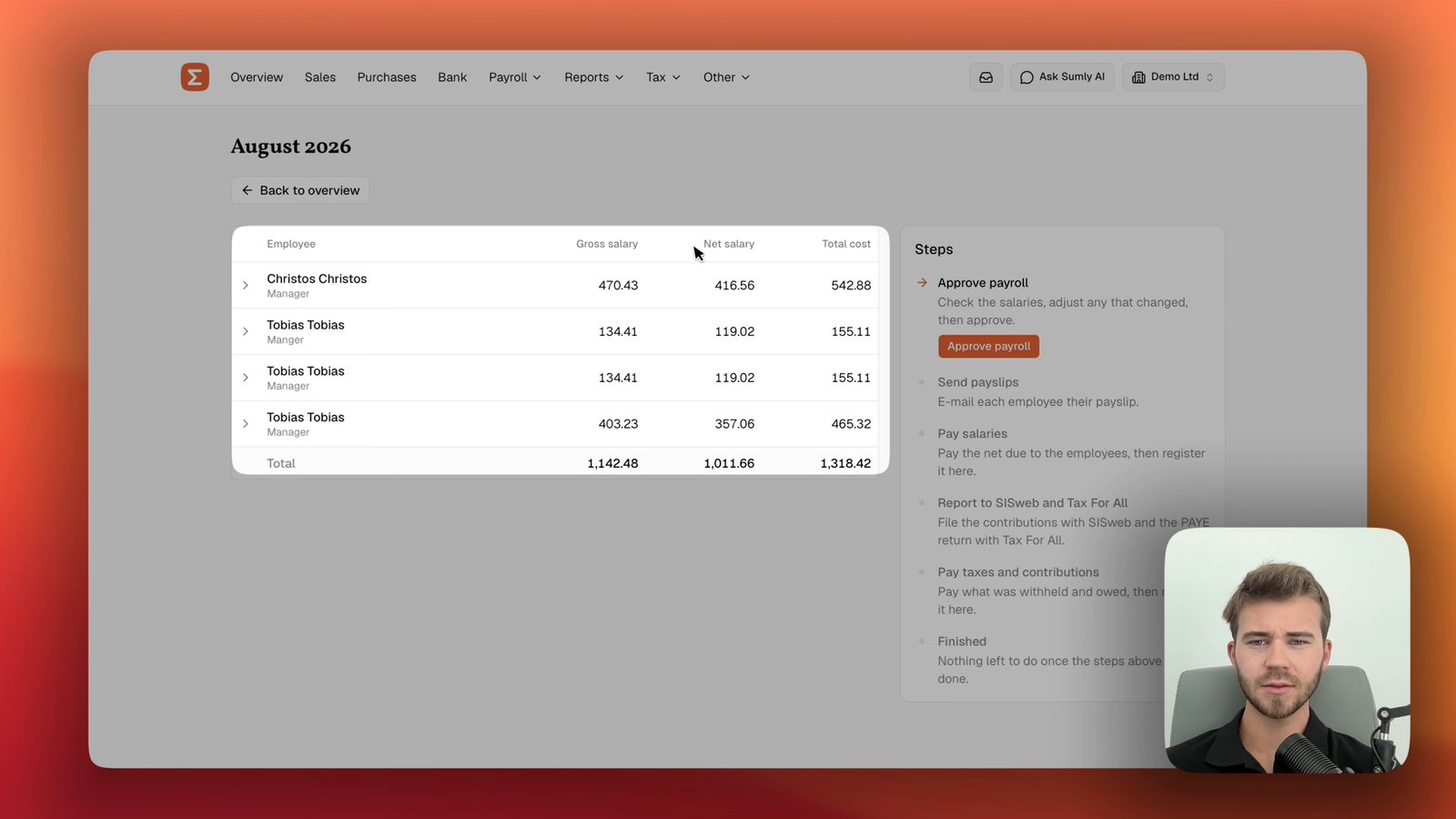
- Payroll
- Compliance
TD7 employer returns in Cyprus: monthly and annual filing through Tax For All
Prepare Cyprus TD7 employer returns from payroll, reconcile the annual totals, fix errors and keep proof of filing and payment in Tax For All.
Sumly team6 min read
Ready when you are.
Start a new company, or bring the one you already have.